

This pre-season I built a full Premier League season simulation model from scratch. The aim is simple, estimate where every club is likely to finish in 2026/27 and identify where those probabilities disagree most strongly with the bookmakers.
What the Premier League model actually does
The model runs a Dixon Coles style Monte Carlo simulation. Rather than trying to predict the final Premier League table directly, it plays out the entire 380-game season 20,000 times.
Each match uses the estimated attacking and defensive strength of the two clubs to calculate the probability of different scorelines. The Dixon Coles element adjusts those probabilities to better reflect tight, low-scoring matches that simpler models often struggle to price accurately.
After 20,000 simulated seasons, I count how often each club wins the title, finishes in the top four, finishes in the top half, gets relegated or lands above or below its points line. Those frequencies become the model probabilities.
The starting point for every club is three seasons of Premier League xG and xGA data, weighted so the most recent campaign carries the greatest influence.
Coventry City, Ipswich Town and Hull City were in the Championship last season, so their numbers need treating differently. I use their Championship data and scale it according to how promoted clubs have historically performed after stepping into the Premier League. A club dominating Championship opposition clearly cannot be expected to produce the same numbers against Premier League teams.
Four further signals then adjust those initial ratings.
Bookmaker prices across the title, top four, top half and relegation markets provide an external assessment of each club's strength. Squad value and net summer transfer spend account for changes in overall squad quality. Managerial changes are included, with the adjustment depending partly on whether the incoming manager inherits a stable club or one already struggling.
The final adjustment is the part I spent the most time building. Every club receives a net transfer quality score using the actual performance of its arrivals and departures across 14 leagues. Minutes, xG, xA and defensive actions per 90 all feed into it, meaning summer business is judged on what players produced rather than simply the size of their transfer fees.
Finally, every club receives its own home advantage based on its actual home and away performance rather than applying the same flat adjustment across all 20 teams.
During the research I also checked the xPTS of each promoted club from last season, a separate measure of underlying performance based on the chances created and conceded across individual matches.
This is not an input within the model itself. I used it separately to stress test some of the more extreme outputs, and it became particularly important when assessing Hull City.
Premier League model bets
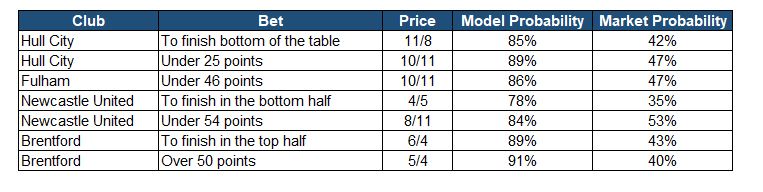
My headline position is Hull City to finish bottom at 11/8.
Even after stripping away every manual adjustment and trusting nothing except the raw model, Hull finish bottom in around 61% of simulations. Once everything is included, that rises above 85%.
Hull won promotion through the playoffs but ranked only 17th of 24 Championship clubs on xPTS. That was the widest gap between results and underlying performance in the division, meaning their promotion significantly flattered how they actually performed.
They also spent last season under a transfer embargo, their summer recruitment has been modest even by promoted club standards and several first-team players enter the campaign injured.
The same weakness appears in another market. Hull under 25 points is 10/11, a price implying around 47%. My model puts the probability at 89%.
That matters because this is not one isolated model output producing an extreme number. Hull look weak across several different measures.
- Hull City to finish bottom at 11/8 at Betway
- Hull under 25 points at 10/11 at Bet365
Fulham to struggle after summer of departures
Fulham provide the next significant disagreement. They have lost three established Premier League regulars this summer in Sasa Lukic, Raul Jimenez and Harry Wilson. All three played significant minutes last season, while Gonzalo Garcia represents essentially the only like-for-like replacement.
The model therefore sees a genuine reduction in squad quality rather than normal summer turnover.
Fulham under 46 points is priced at 10/11, implying around 47%. My model puts the probability at 86%. That is one of the biggest gaps anywhere in the points markets.
- Fulham under 46 points at 10/11 with Bet365
Newcastle United to struggle after loss of key players & manager
Newcastle provide another strong disagreement between model and market.
Bruno Guimaraes, Anthony Gordon and Sandro Tonali have all departed in the same window, removing three established players from the spine of the side. Their replacements are predominantly younger and less proven at Premier League level.
There is also uncertainty around the managerial change. Matthias Jaissle begins his first season in the Premier League and has spoken publicly about the leadership lost from the dressing room and the need to strengthen at full-back.
The market implies around a 65% chance of Newcastle finishing in the top half. My model puts that figure at only 22%.
The same concern appears in their points line. Newcastle under 54 points is available at 8/11, implying around 53%, against an 84% probability from the model. Again, it is the consistency across different markets that interests me rather than one extreme output.
- Newcastle under 54 points at 8/11 with Bet365
Buzzing Bees to continue impressive form of last term
Brentford provide the strongest disagreement in the opposite direction. Their underlying numbers give the model a solid starting point. Across the three-season sample, Brentford have averaged 1.55 xG against 1.38 xGA per game, already producing a positive underlying process before this summer's transfer activity is considered.
Mamadou Sangare's arrival from Lens adds further quality in defensive midfield and scores well within the transfer component of the model. The model gives Brentford an 89% chance of finishing in the top half against a market probability of 43%.
The points market supports the same view. Brentford over 50 points is 5/4, implying 40%, while the model has it at 91%.
- Brentford over 50 points at 5/4 with Bet365
Why these four Premier League clubs stand out
The model produces probabilities across five different markets, title, top four, top half, relegation and season points.
For most clubs, those probabilities sit reasonably close to the market. There might be an interesting difference in one area, but nothing significant enough elsewhere to strengthen the case.
Hull, Fulham, Newcastle and Brentford are different.
The disagreement repeatedly appears across multiple markets. Hull rate poorly for relegation, finishing bottom and their points total. Newcastle rate poorly for both the top half and their points line. Brentford rate strongly for both the top half and their points total.
That matters because I trust a repeated signal considerably more than one extreme probability sitting on its own.
Premier League bets that did not get over the line
Not every large difference becomes a bet.
Nottingham Forest initially looked concerning. They have been the Premier League's biggest net seller after Elliot Anderson left for a club-record £116m, but the subsequent reinvestment looks sensibly targeted rather than the product of a fire sale. I am leaving Forest alone for now.
Leeds United produce the single biggest model versus market difference anywhere in the database. The problem is what drives it. A significant part of the edge comes from their individual home advantage, which is based on only one season of relevant data. I do not trust that sample enough to put money behind the output yet.
Brighton were another club worth investigating beyond the headline model number. Their summer includes meaningful departures, but nothing approaching the talent drain seen at Fulham. Their record of selling players for significant fees and replacing them effectively also gives me enough reason to leave them alone.
Bournemouth's position survived the same scrutiny. Their underlying numbers supported last season's top-six finish and Marco Rose arrives with a strong reputation. I found little away from the model to justify overriding their rating.
Updating the Premier League model
This is not a one-off pre-season exercise.
As the season develops, actual Premier League results will begin replacing assumptions. Injuries will alter squad strength, the remaining summer transfer business will change ratings and January recruitment will provide another significant update.
I will rerun the simulation as those inputs change and publish new positions whenever the movement becomes large enough to justify it.
That also means none of these positions gets protected simply because it was a preseason bet. If the evidence changes, the model changes with it.

The Betting Desk is run by Neil Potter. Neil built and refined all of the site’s data models, helping it grow into a trusted source of analysis across the Premier League, EFL and major tournaments. His models track key metrics, long term trends and areas where market prices move away from underlying performance.


































 GambleAware