
This is a guide to using our own probability model to identify value in the outright and stage betting markets. Over the course of the World Cup the model will be updated and shared. As matches are complete the odds will shift and betting opportunities will arise.
First Things First: What Do The World Cup Odds Actually Tell You?
Most people look at outright odds and immediately think about the potential payout. Spain at 4/1. Argentina at 8/1. Norway at 25/1. The focus tends to be on how much money could be won if the bet lands.
The more useful number is the probability hidden inside those odds. Spain's 4/1 price implies roughly a 20% chance of winning the World Cup. Argentina's 8/1 price implies an 11% chance. Norway's 25/1 price implies around a 4% chance.
Once you start looking at prices in terms of percentages rather than payouts, betting becomes a very different exercise. The question is no longer who is most likely to win the tournament. Instead, the question becomes whether the bookmaker has correctly assessed each team's chances.
That distinction matters because betting is not about predicting winners. It is about identifying value. A team can be less likely to win the World Cup than Spain and still represent a better betting opportunity if the market has underestimated their chances.
The purpose of this article is not to tell you who will win the 2026 World Cup. Nobody knows that. Instead, it is to identify where the betting market may be overestimating or underestimating particular teams.
Why The Bookmaker Always Has An Edge
Before looking at the model itself, it is worth understanding the challenge every bettor faces.
If you convert every outright price into an implied probability and add them together, the total does not come close to 100%. Instead it sits somewhere around 115%. That additional 15% is the bookmaker margin.
Every team is priced slightly shorter than their true probability, allowing the bookmaker to build a profit into the market regardless of who eventually lifts the trophy.
This means randomly selecting teams will lose money over time. Even identifying a few winners is often not enough because the prices themselves are stacked against the bettor.
The only way to gain an edge is to find situations where a team's true probability appears greater than the probability implied by the odds. That is exactly what the model attempts to do.
How our World Cup Model Works
The model simulates the entire 2026 World Cup 100,000 times.
Each simulation starts with the group stage. The group matches are played, teams qualify or are eliminated, knockout rounds are completed and eventually a champion is crowned. The process is then repeated again and again until 100,000 full tournaments have been generated.
At the end of those simulations, the results are counted. If Argentina win 13,000 tournaments, they receive a 13% probability. If Brazil win 5,000 tournaments, they receive a 5% probability.
The model is driven by three main factors. The first is the betting market itself. Every group stage fixture is simulated using current match odds, with bookmaker margin removed before probabilities are applied.
As an example, if Brazil are 4/6 to beat Morocco then this implies they will win 56% of the time. In the other 46% of the simulations run through the model, Morocco will either draw or win.
The second is outright market strength. Once the knockout rounds begin, team ratings are driven primarily by their outright winner prices. A team available at 4/1 is treated as considerably stronger than a team available at 40/1. Qualifying performance is then used to adjust those ratings. Nations that dominated qualification receive a boost, while those that scraped through or underperformed receive a downgrade.
The final adjustment concerns geography.
Why Geography Matters More Than Most People Realise
Perhaps the most important factor in the model is geography. World Cups have historically been won by nations operating relatively close to home. The pattern is not perfect, but it is difficult to ignore.
The 2026 World Cup is being staged across the United States, Mexico and Canada. Historically, tournaments held in the Americas have overwhelmingly favoured South American nations.
Uruguay won the inaugural World Cup on home soil in 1930. Brazil lifted the trophy in Chile in 1962, Mexico in 1970 and the United States in 1994. Argentina won in Mexico in 1986. Germany's triumph in Brazil in 2014 remains the only European success in an Americas-hosted World Cup.
In total, South American nations have won seven of the eight World Cups staged in North or South America.
To reflect that trend, South American teams receive a 10% strength boost within the knockout rounds of the model. The three host nations receive an additional uplift. European nations receive a modest reduction.
This does not guarantee success for Argentina, Brazil or Uruguay. It simply acknowledges a historical pattern that has repeated itself for almost a century.
How To Read The World Cup Table
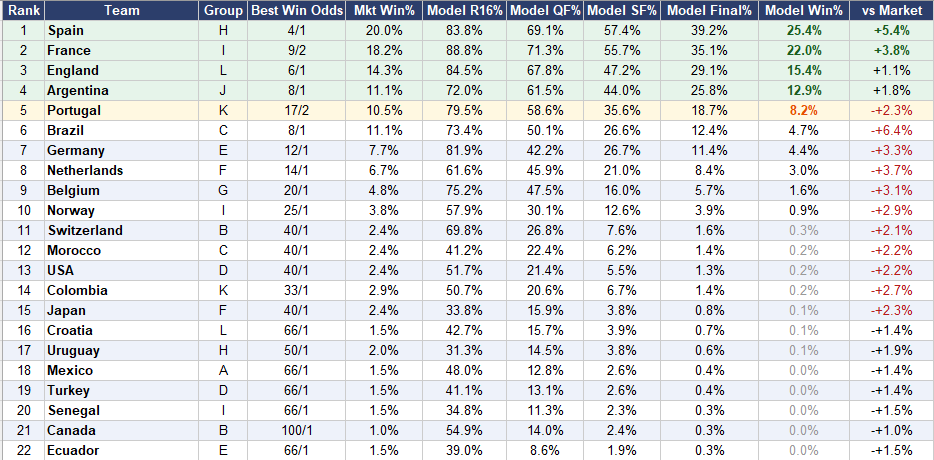
The key columns are “Model Win%” and “Mkt%”. Model Win% shows how often a team won the World Cup across 100,000 simulations, while Mkt% is the probability implied by their current outright odds.
If Model Win% is higher than Mkt%, the model believes the team has a better chance than the market suggests. If Mkt% is higher, the team may be overpriced.
R16%, QF%, SF% and Final% show the probability of reaching each stage, helping identify value in stage markets. The Verdict column combines the model, market pricing, draw, qualifying form and historical trends.
What The World Cup Model Is Really Telling Us
The most interesting thing about the table is not who sits at the top. Everyone expects Spain, France and England to rank highly. The more interesting question is why Argentina emerge as the strongest betting proposition despite sitting behind all three European nations in the outright rankings.
The answer lies in understanding the difference between prediction and value. Spain may be the strongest team in the tournament. France may have the deepest squad. England may have one of the most favourable paths through the draw.
That does not automatically make them the best bets. The market already knows those things. The objective is not to find the strongest team. It is to find the strongest team relative to their price.
Argentina At 8/1: The Strongest Outright Case
Argentina emerge as the clearest outright selection because several independent factors all point in the same direction.
They topped South American qualifying by a comfortable margin and avoided the inconsistency that affected Brazil, Uruguay and Colombia. Unlike many of their rivals, there are very few obvious weaknesses in their profile.
The group draw is favourable. Algeria, Austria and Jordan represent one of the softer assignments among the leading contenders, increasing the probability of Argentina winning the group and securing a manageable route through the knockout rounds.
The geography adjustment also works strongly in their favour. South American nations have consistently excelled when World Cups are staged in the Americas and Argentina receive the full benefit of that historical trend within the model.
Crucially, the outright price remains attractive. The market implies an 11% chance of winning the tournament. The model places that figure at 13%. A two-point edge may not sound dramatic, but outright markets are generally efficient. Finding a team with positive value while also possessing a favourable draw and strong historical support is uncommon.
The obvious concern is the defending champion factor. Only Italy in 1938 and Brazil in 1962 successfully retained the World Cup. Every defending champion since has failed. That trend cannot be ignored. Even so, Argentina remain the one team where qualifying form, tournament path, geographical advantage and market price all align.
BACK: Argentina at 8/1.
Brazil At 9/1: The Market Versus The Model
No team creates a bigger disagreement than Brazil. The bookmaker implies roughly an 11% chance of winning the World Cup. The model gives them only 5%. That difference exists for good reason. Brazil's qualifying campaign was surprisingly poor by their standards. They suffered six defeats and never established the dominance usually associated with a World Cup favourite.
The projected knockout route is also demanding. Difficult opponents arrive early and the path towards the final appears significantly tougher than Argentina's. Those factors drag Brazil down the rankings. The market, however, is clearly pricing something else.
No nation has a stronger World Cup record than Brazil. They have repeatedly won major tournaments away from home and remain synonymous with international football success. More importantly, they benefit from the same geographical trends that favour Argentina.
This creates one of the most fascinating debates in the market. Do you trust recent evidence, which suggests Brazil are vulnerable? Or do you trust nearly a century of World Cup history, which suggests South American nations thrive when tournaments are staged in the Americas?
WATCH: Brazil at 9/1.
Spain, France And England: The European Dilemma
The model ranks Spain, France and England as the three strongest teams in the tournament. That should not be surprising. All three possess elite squads, favourable groups and strong probabilities of reaching the latter stages.
Spain top the rankings because they consistently progress deep into the simulations. Their route through the competition is relatively favourable and the underlying market already rates them as the strongest side in the field.
France sit close behind. Their group stage progression rate is exceptionally high and they remain one of the most balanced teams in world football.
England also rate strongly. Their probability of reaching the quarter-finals and semi-finals compares favourably with every nation outside Spain and France.
On footballing quality alone, all three deserve their place near the top of the rankings. The issue is price. Spain at 4/1, France at 9/2 and England at 6/1 leave little room for error. History also provides a significant warning. Only one European nation has won a World Cup hosted in the Americas. Germany's triumph in Brazil in 2014 stands alone against a backdrop of South American dominance.
That does not mean Spain, France or England cannot win. It simply means bettors are being asked to take relatively short prices on teams attempting to overcome one of the strongest historical trends in World Cup history.
AVOID: Spain, France and England.
Do Portugal have too much respect from the market? Portugal sit in an awkward position. The market implies a 10% chance of winning the tournament. The model places them closer to 8%. Unlike Spain and France, there is no positive discrepancy between market and model. Portugal also face the possibility of difficult knockout opponents relatively early in the tournament, including teams benefitting from the South American geographical adjustment.
They remain one of the strongest sides in the competition and should progress comfortably from the group stage. The problem is purely one of value. The current price appears to reflect Portugal's ceiling rather than their most likely outcome.
AVOID: Portugal at 17/2.
Morocco: The Best Outsider In The Tournament
Morocco are unlikely to win the World Cup. The model gives them less than a 1% chance of lifting the trophy. That statistic alone will cause many bettors to dismiss them. Doing so would be a mistake. Morocco's outright probability is low because winning the tournament requires a team to defeat several elite nations in succession. That challenge is enormous for any outsider.
The more revealing numbers are elsewhere. The model gives Morocco a 22% chance of reaching the quarter-finals and a 6% chance of reaching the semi-finals. Those figures are supported by recent evidence.
Morocco became the first African nation to reach a World Cup semi-final in 2022 and followed that achievement with an outstanding qualifying campaign, winning all eight matches while conceding only two goals. The outright market may be ambitious but the stage markets are where the value lies.
BACK: Morocco to reach the quarter-finals.
Ecuador: The Forgotten South Americans
Ecuador's qualifying campaign deserves far more attention than it receives. They finished above Brazil, Uruguay and Colombia in South American qualifying and demonstrated a level of consistency rarely associated with teams available at long prices. The problem is not the group stage but what comes afterwards. The projected knockout route becomes increasingly difficult, limiting their outright prospects.
That makes Ecuador a poor outright bet but an interesting proposition in qualification markets.
WATCH: Ecuador to qualify from the group and reach the Last 16.
Why Stage Markets Might Be Better Than Outrights
Many bettors focus exclusively on the winner market. The stage markets may offer stronger opportunities. Switzerland provide a perfect example. Their chances of winning the World Cup remain slim, but the model gives them a 70% probability of reaching the Last 16. That is a very different proposition.
Belgium also stand out. Their outright chances are limited, yet the model gives them a 47% probability of reaching the quarter-finals.
Norway fall into a similar category. Their outstanding qualifying campaign resulted in a 58% probability of reaching the Last 16 despite remaining outsiders in the outright market.
Canada benefit from home advantage and a favourable group. The model gives them a 55% chance of reaching the knockout rounds despite their triple-figure outright price.
These markets ask simpler questions. Can a team get through a group? Can they win one knockout tie?
Those questions are often easier to answer than predicting the eventual champion.
Recommended World Cup Bets
- Argentina To Win The World Cup at 8/1 with AKBets – The strongest combination of value, qualifying form, draw and geographical advantage.
- Morocco To Reach The Quarter-Finals at 7/2 with Matchbook – Outstanding recent tournament pedigree and a stronger profile than their outright odds suggest.
- Switzerland To Reach The Last 16 at 13/5 with Skybet– The model gives them a 70% probability of progressing from the group.
- Norway To Reach The Last 16 at 12/5 with Betfair – An excellent qualifying campaign and a realistic path into the knockout rounds.
*Odds correct at the time of writing.

The Betting Desk is run by Neil Potter. Neil built and refined all of the site’s data models, helping it grow into a trusted source of analysis across the Premier League, EFL and major tournaments. His models track key metrics, long term trends and areas where market prices move away from underlying performance.

































 GambleAware