
The model ran the 2026 World Cup 100,000 times and Brazil lifted the trophy in just 4.8% of those simulations. Their outright odds of 8/1 imply an 11.1% chance of winning the tournament, creating one of the largest gaps between market expectation and model probability among the leading contenders.
That does not mean Brazil cannot win the World Cup. They remain one of the most talented squads in the competition and now have Carlo Ancelotti in charge. The issue is whether 8/1 accurately reflects their chances of going all the way. Based on the model, it does not.
Brazil are being priced alongside the strongest teams in the field, yet the data paints a very different picture. Their qualifying campaign was poor by their own standards, their projected route through the knockout stages is one of the toughest among the favourites and much of the confidence surrounding them appears to be driven by historical success rather than what this specific team has achieved over the last two years.
The Problem in One Sentence
Brazil are available at 8/1 to win the 2026 World Cup, implying an 11.1% chance of lifting the trophy. The model gives them only a 4.8% chance after 100,000 simulations, suggesting the market is significantly overestimating their prospects.
That is not a marginal difference. The market is effectively valuing Brazil as more than twice as likely to win the tournament as the model does. For bettors searching for value, those are exactly the types of discrepancies that matter.
Reason One: Their Qualifying Campaign Was a Warning Sign
Before discussing knockout paths or historical trends, it is worth looking at how Brazil reached the tournament in the first place.
South American qualifying is widely regarded as the toughest qualification process in international football. Every nation plays 18 matches and there are very few opportunities to hide weaknesses over such a long campaign. Brazil eventually qualified, but they did so with the weakest record of any South American nation appearing at this World Cup.
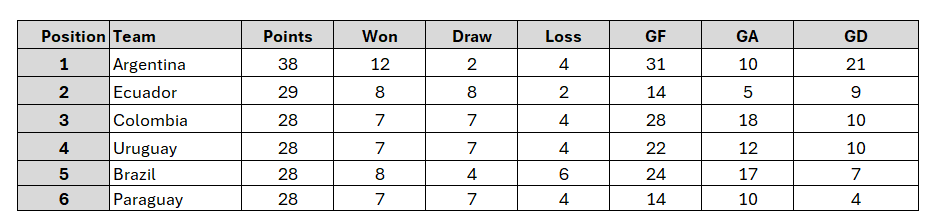
The headline figure is the six defeats. Brazil were the only South American side at this World Cup to lose six qualifiers and, remarkably, suffered more defeats during this campaign than they had across the previous five qualifying cycles combined.
They also finished 10 points behind Argentina, recorded a goal difference of just +7 and ended the campaign behind Ecuador, Colombia and Uruguay. For most nations those numbers would still represent a respectable qualification process. For Brazil they represent a significant decline.
The concerns extended beyond the results themselves. Midfield balance remained an issue throughout the campaign, managerial instability disrupted continuity and Dorival Junior was eventually replaced by Ancelotti before qualification was complete. While there is little doubt Ancelotti improves Brazil's prospects going forward, he inherits a squad that has not consistently performed at the level normally associated with a World Cup favourite.
Qualifying form is one of the key inputs within the model and Brazil score noticeably lower than the other South American contenders in that area. Even after applying the 10% geography adjustment awarded to South American nations, their overall rating remains considerably weaker than their market position suggests.
For a nation with Brazil's history, finishing fifth and losing six qualifiers should not be dismissed as a minor blip. The model treats it as a meaningful indicator of current strength and it is one of the biggest reasons Brazil's outright probability falls so far below the market's assessment.
Reason Two: Their Path Through the Tournament Is Brutal
Even if you completely ignore the qualifying concerns, Brazil still face another significant obstacle. Their projected route through the knockout stages is one of the most difficult of any top seed in the tournament.
The model simulates every possible path through the bracket and repeatedly arrives at the same conclusion. Brazil face strong opposition almost immediately and are likely to encounter several of the tournament's most dangerous teams before reaching the final.
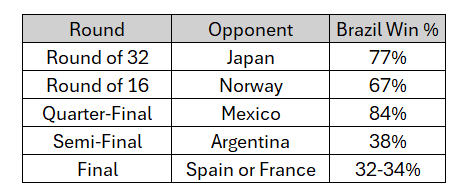
At first glance those individual percentages do not look disastrous. Brazil would be expected to beat Japan and would still be favourites against Norway and Mexico. The problem is that World Cups are not won one match at a time in isolation. Every hurdle has to be cleared consecutively.
Norway are a particularly awkward opponent. They produced the strongest qualifying campaign of any European nation, winning all eight matches, scoring 37 goals and conceding only five. The model gives Brazil a 67% chance in that matchup, which means they are eliminated before the quarter-finals roughly one time in three.
If Brazil reach the semi-finals, Argentina are the most likely opponent. That is where their outright hopes take a major hit. The model gives Brazil only a 38% chance of winning that match, meaning they lose nearly two-thirds of the time when the two sides meet.
Even reaching the final does not solve the problem. Spain and France are both projected to be stronger than Brazil on neutral ground, leaving them with only around a one-in-three chance of lifting the trophy even if they make it that far.
When those probabilities are combined, Brazil's overall tournament win percentage falls rapidly. The model gives them only a 49% chance of reaching the quarter-finals and a 27% chance of reaching the semi-finals. By the time the later rounds are factored in, the overall figure settles almost exactly where the simulation places it, at 4.8%.
This is not a team benefitting from a favourable draw. It is a team that is likely to face Norway, Argentina and either Spain or France in successive rounds if they are to win the tournament. That is a difficult route for any nation, regardless of reputation.
Reason Three: The History Argument Is Weaker Than It Looks
The strongest case for Brazil at 8/1 is not based on their recent performances or their route through the tournament. It is based on history.
South American nations have traditionally thrived when the World Cup is played in the Americas, winning seven of the previous eight editions staged in North or South America. Brazil themselves have won five World Cups away from home, more than any other nation, and many bettors will naturally look at those trends and conclude that this tournament sets up perfectly for another Brazilian run.
There is certainly some logic behind that argument. Geography forms part of the model and South American nations receive a 10% strength adjustment to reflect their historical success in Americas-hosted tournaments. The key point, however, is that this advantage is already built into the numbers. The 4.8% win probability is not being generated by a model that ignores history. It is being generated by a model that already accounts for it.
The problem for Brazil is that even after receiving that adjustment, their overall rating remains significantly lower than their market position. Their qualifying campaign was weaker than the other major South American contenders and their route through the knockout stages is among the toughest of any leading nation. Those factors are large enough to outweigh much of the geographic advantage.
There is also a tendency to compare this Brazil side with some of the greatest teams the sport has ever produced. Brazil's victories in Chile in 1962, Mexico in 1970 and the United States in 1994 are often cited as evidence that they know how to win World Cups in the Americas. What is often overlooked is the quality and profile of those teams.
This current Brazil side does not arrive with a similar profile. They finished fifth in CONMEBOL qualifying, lost six matches and spent much of the cycle searching for tactical balance. While there is undeniable talent throughout the squad, there is little evidence that they belong in the same conversation as the Brazilian teams whose achievements underpin the historical argument.
History is an important part of the picture, but it should not be the entire picture. The geography angle supports South American nations generally. It does not automatically make every Brazil team a value bet.
Reason Four: The Price Simply Does Not Reflect the Reality
Ultimately this comes down to price. Brazil are available at 8/1, implying an 11.1% chance of winning the tournament. The model gives them a 4.8% chance after 100,000 simulations. That leaves a gap of 6.3 percentage points between the market and the model.
Put another way, the market is valuing Brazil as more than twice as likely to win the World Cup as the simulation suggests they are.
The comparison with Argentina is particularly revealing.
- Bookmaker implied probability for Argentina: 11.1%
- Model win probability for Argentina: 12.8%
- Bookmaker implied probability for Brazil: 11.1%
- Model win probability for Brazil: 4.8%
Both teams are available at the same price. The model believes Argentina should be shorter and Brazil should be longer. That alone tells you everything you need to know about how differently the two teams are being assessed.
Argentina topped South American qualifying by 10 points, finished with a goal difference of +21 and avoided many of the concerns that followed Brazil throughout the cycle. They also benefit from the same geographical factors that many bettors cite when backing Brazil.
The reason the market keeps the two teams at similar prices is not difficult to understand. Brazil remain one of the most recognisable sporting brands in the world. They attract support from casual bettors, neutral fans and anyone drawn to their history and reputation. That weight of money inevitably influences the market.
The result is a price that appears to contain a premium simply for being Brazil.
Whether you call it a reputation tax, a brand premium or a glamour factor, the effect is the same. Bettors are being asked to pay a price that the underlying numbers do not support.
When two teams are available at identical odds and one is rated at 12.8% by the model while the other is rated at 4.8%, they are clearly not offering the same value proposition.
So What Should You Do Instead?
None of this guarantees Brazil will fail.
International tournaments are inherently volatile and history is full of examples of teams arriving with question marks before finding form at exactly the right moment. Brazil themselves did something similar in 1994, entering the tournament amid doubts before lifting the trophy a month later.
The issue is not whether Brazil can win. The issue is whether their current odds compensate you adequately for the risk involved.
At 8/1, the market is effectively asking bettors to believe Brazil win the World Cup roughly once every nine tournaments. The model suggests the true figure is closer to once every 21 tournaments. That is a significant difference.
For those who believe strongly in the South American advantage, Argentina represent a much stronger version of the same argument. They benefit from the same geography, produced a superior qualifying campaign and are rated more favourably by the model while trading at the same odds.
For those specifically interested in Brazil, the stage markets appear far more logical. The model gives them a 74% chance of reaching the Round of 16 and approximately a 50% chance of reaching the quarter-finals. Those probabilities align much more closely with the profile of this team than the outright winner market.
Brazil remain a dangerous side capable of beating anyone on their day. The issue is that winning five consecutive knockout matches against a projected route featuring Norway, Argentina and either Spain or France is an entirely different challenge.
The model ran the tournament 100,000 times and Brazil lifted the trophy in fewer than five out of every 100 simulations. For a team priced at 8/1, that is a difficult number to ignore.

The Betting Desk is run by Neil Potter. Neil built and refined all of the site’s data models, helping it grow into a trusted source of analysis across the Premier League, EFL and major tournaments. His models track key metrics, long term trends and areas where market prices move away from underlying performance.

































 GambleAware
Interesting. Can you tell us who is overpriced versus the model’s expected win %
Brazil are the most overpriced team in the entire market. The bookmaker implies 11.1% at 8/1. The model gives 4.8%. That is a gap of 6.3 percentage points which means that the market is more than twice as generous as the model.
Portugal at 17/2 imply 10.5%. The model gives 7.9%. A gap of 2.6 percentage points, and the geography argument adds a further discount on top.
Uruguay at 50/1 imply 2.0%. The model gives 0.1%. Small numbers but proportionally the market is around 20 times more generous than the model.
Colombia at 33/1 imply 2.9%. The model gives 0.2%. The South American geography boost is already embedded in the model figure and still can’t bring them close to market implied.